
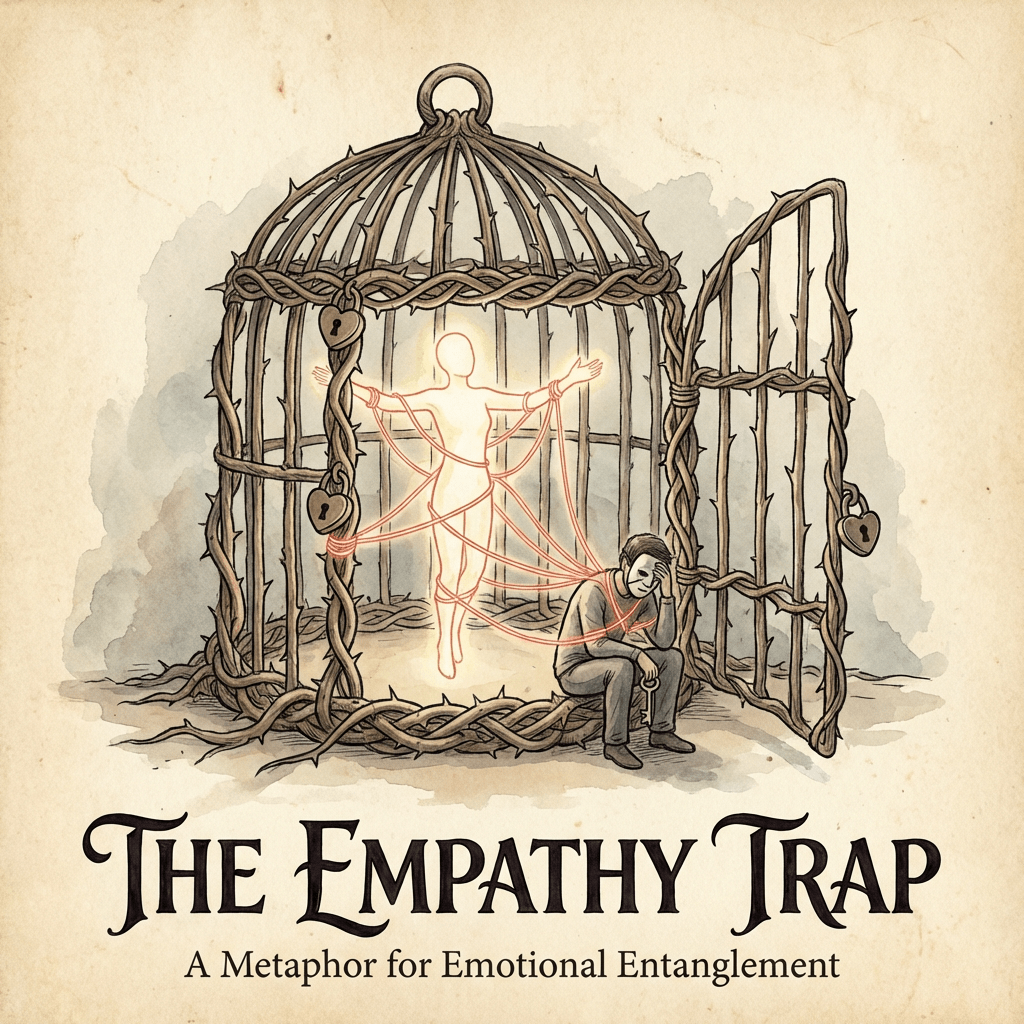
Why “Feeling Too Much” Can Be a Safety Risk.
The Paradox of the Over-Empath
In Aotearoa, we value Manaakitanga and the ability to feel for our whānau. However, in the context of family violence (FV), “unfiltered empathy” can inadvertently cloud your tactical judgment. When you “marry” your emotional state to a survivor’s trauma, you lose the objective distance required to be a Kaitiaki. This page explores how to maintain your heart without losing your head.
1. The “Trauma Blur” (Mirror Neurons)
Our brains are wired with mirror neurons that allow us to feel what others feel. For a high-empathy supporter, witnessing a victim’s distress can trigger a “Secondary Trauma” response.
- The Risk: If you are as distressed as the victim, you cannot be their Anchor. You become two people drowning in the same sea, rather than one person holding the rope from the shore.
- The Sane Fix: Practice Compassionate Detachment. You can care deeply about the outcome without “absorbing” the agony of the moment.
2. Empathy for the Perpetrator (The “Understanding” Trap)
This is the most dangerous form of over-empathy. Because many perpetrators have their own history of trauma, high-empathy supporters often find themselves making excuses for the violence.
- The Risk: Understanding why someone is violent (e.g., “He had a hard childhood”) is not the same as accepting the violence. Over-empathy for the perpetrator leads to Minimization. It shifts the focus from the victim’s safety to the perpetrator’s “healing.”
- The Sane Truth: Explanation is not Justification. Your empathy for the perpetrator’s past must never override the victim’s right to a safe present.
3. Decision-Fatigue and “Rescuer” Burnout
When you have too much empathy, you often take on the burden of “fixing” the situation. You start making calls, suggesting moves, and pushing for exits before the survivor is ready.
- The Risk: This mirrors the perpetrator’s behavior by stripping the survivor of their Autonomy. If you are doing all the “emotional lifting,” the survivor isn’t building the internal muscles they need to sustain their own safety.
- The Sane Fix: Be a Witness, not a Rescuer. Your job is to hold the space (Te Ātea), not to live their life for them.
Tactical Tool: The “Empathy Filter”
Use this mental checklist when you feel yourself becoming overwhelmed by a victim’s situation:
- Is this my emotion or theirs? (Identify if you are “absorbing” their fear).
- Am I making excuses for the harm? (Check if your empathy is shifting toward the perpetrator).
- Am I trying to control the outcome? (Check if you are overstepping into “Rescuer” mode).
 Staying Safe and Sane